
Lacrifill vs Punctal Plugs: Dry Eye Treatment Guide
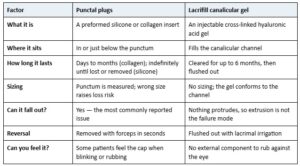
Lacrifill canalicular gel and punctal plugs both treat dry eye the same way: by slowing tear drainage so your own tears stay on the eye longer. Punctal plugs are tiny silicone or collagen inserts placed at the tear duct opening.
Lacrifill is a cross-linked hyaluronic acid gel injected into the canaliculus, where it conforms to the channel, lasts up to six months, and can be flushed out if you do not like it.
Key Takeaways
- Both are tear conservation, not tear production. Occlusion keeps existing tears on the surface longer. It does not make your glands produce more tears, and it does not cure dry eye disease.
- Lacrifill is a gel, not a device you can feel. It is FDA-cleared for up to six months of use, needs no sizing, and is removed by flushing the tear duct rather than by pulling out a plug.
- Plugs are proven, reversible and inexpensive, but they fall out. Across the published literature, spontaneous plug loss is the single most common problem, reported in roughly 40% of patients.
- The pivotal trial favored the gel on tear volume and corneal health. Schirmer scores and corneal staining improved through six months with Lacrifill, while staining worsened at six months in the plug comparison arm.
- Inflammation comes first. Sealing the drain before you calm the ocular surface can keep inflamed tears in contact with the eye, which is why most dry eye specialists treat inflammation before recommending either option.
What Is Lacrifill Canalicular Gel, and How Does It Work?
Lacrifill canalicular gel is a cross-linked hyaluronic acid filler that a doctor injects into the canaliculus, the small drainage channel behind the tear duct opening in your eyelid.
Nordic Pharma received FDA 510(k) clearance for the device in January 2022 and launched it in the United States in spring 2024. Rather than sitting in the punctum like a stopper, the gel flows in and fills the length of the channel, forming a soft, conforming block that keeps your natural tears on the ocular surface instead of letting them drain into your nose.
The procedure takes a few minutes in the exam chair. Your doctor places a fine cannula tip at the punctum and injects the gel; when gel appears at the upper punctum, both channels on that side are filled.
One prefilled syringe holds enough material to treat all four canaliculi. Because the gel adapts to the anatomy it fills, there is no plug size to measure and no risk of choosing a size that is slightly too small.
FDA clearance was based on a 157-patient randomized, double-masked, multicenter study that compared the gel against an intracanalicular plug in patients with at least moderate dry eye. Mean Schirmer scores improved from baseline by 3.9 mm at three months and 3.8 mm at six months with the gel, versus 1.9 mm and 1.8 mm with the plug.
Roughly 84% of patients in each group reached a clinically meaningful improvement in their Ocular Surface Disease Index score, so symptom relief was comparable. The clearer separation was on the eye itself: corneal staining decreased through six months with the gel and increased at six months in the plug arm.
Two limits are worth stating. The trial was the manufacturer’s clearance study, and it compared the gel to one specific intracanalicular plug rather than to every punctal plug on the market. And the gel arm reported more ocular pain (9.7% versus 0%) and slightly more watering, so it is not automatically the gentler option for every patient.
Punctal Plugs for Dry Eye: What They Do Well, and Where They Fall Short
Punctal plugs have been a staple of in-office dry eye treatment for decades, and Village Eyecare uses them alongside therapies such as BlephEx, TearCare and thermal pulsation.
Collagen plugs dissolve over days to months and are often used as a trial run. Silicone plugs sit in the punctum with a small visible cap and are meant to stay until they are removed or lost. Both cost less than newer options, both go in without stitches, and both can be taken out in seconds if the eye waters too much.
The trade-off is retention. In one prospective cohort of silicone plugs, 84.2% were still in place at three months, 69.5% at one year and 55.8% after a median of two years.
Other series have found much lower retention, with one study estimating an overall probability of 49.4% and spontaneous extrusion as the most common complication. Pooled across the literature, plug loss is reported in about 40% of patients.
Plugs also occasionally cause epiphora, local irritation or, less often, granuloma formation. In that same long-term cohort, canalicular narrowing after a plug was lost occurred in 34.2% of eyes by two years, although patients did not notice it.
None of this makes plugs a poor choice. It does explain why patients who quietly lose a plug every few months, or who have already had two or three replaced, tend to be the ones asking about alternatives.
Lacrifill vs Punctal Plugs: Comfort, Cost, and Candidacy
How the Two Options Compare
Punctal Occlusion Cost and Insurance
Both procedures are billed under the same CPT code, 68761 (closure of the lacrimal punctum by plug). Based on national average Medicare figures published by the manufacturer for 2026, reimbursement runs about $215 for a bilateral procedure and about $323 when all four puncta are treated.
Those numbers describe what a practice is paid, not what you will owe. Your share depends on your medical plan, your deductible and whether your dry eye diagnosis meets the plan’s medical-necessity criteria this is medical coverage, not routine vision coverage.
There is currently no dedicated Local Coverage Determination for Lacrifill, so payers apply general reasonable-and-necessary standards, and prior authorization is sometimes requested. Ask the front desk for a benefits check before the visit rather than after.
Who Is a Good Candidate for Either Procedure
Occlusion is designed for aqueous-deficient dry eye, meaning you are not making enough tear volume. If your problem is evaporative driven by meibomian gland dysfunction blocking the drain does little, because the tears you keep still evaporate too quickly.
Those patients usually do better with gland-focused care first, and our comparison of LipiFlow, IPL and warm compresses explains how those treatments differ.
Sequence matters, too. The Dysfunctional Tear Syndrome (Delphi) panel and subsequent dry eye workshop reports both advise controlling ocular surface inflammation before occluding drainage, since retained inflammatory tears can worsen symptoms in some patients.
A practical order of operations looks like this: identify the type of dry eye with tear film testing, address inflammation and lid disease, optimize lubricating drops, then consider a plug or gel as maintenance. For severe surface disease that occlusion alone cannot manage, scleral lenses hold a reservoir of fluid against the cornea all day and may be the better tool.
Frequently Asked Questions
Are punctal plugs painful to insert?
Most patients describe insertion as pressure rather than pain. The procedure takes about a minute per eye, usually with a numbing drop, and there is no needle, incision or recovery time. You can drive home and return to work. Mild awareness or a gritty feeling for a day or two is common; sharp or persistent pain is not, and it is worth a call to your eye doctor.
How long does punctal occlusion last?
It depends on what is used. Collagen plugs dissolve within days to a few months and are typically a trial. Silicone plugs have no expiration date but are frequently lost published retention runs roughly 84% at three months and about 70% at one year, with wide variation between studies. Lacrifill is cleared for up to six months, after which it should be removed by lacrimal irrigation; its safety beyond six months has not been established.
Do punctal plugs fall out, and what happens if one does?
Yes, and it is the most commonly reported problem with them, affecting roughly 40% of patients in pooled reviews. Plugs are usually lost during sleep or eye rubbing, and most people never see it happen. The signal is that your symptoms quietly return over a week or two. Nothing dangerous occurs when a plug is lost, but the drainage channel can narrow over time after repeated losses, so mention it at your next visit instead of waiting.
Do punctal plugs cure dry eye?
No. Punctal occlusion is a tear conservation strategy, not a cure. It keeps the tears you already produce on the eye longer, which can meaningfully reduce burning, grittiness and drop dependence, but it does not restore lacrimal gland function, repair meibomian glands or resolve inflammation. Dry eye disease is chronic and progressive, so occlusion works best as one component of an ongoing plan.
Is Lacrifill covered by insurance?
Often, though not automatically. It is billed under the existing punctal occlusion code (68761) through medical insurance rather than a vision plan, and there is no dedicated coverage policy specific to the product yet, so payers evaluate it under general medical-necessity rules.
Coverage decisions vary by plan and by state Medicare schedule, and some plans ask for documentation of failed prior therapy. Request a benefits verification before scheduling.
The Bottom Line and Your Next Steps
Neither option is universally better. Punctal plugs are inexpensive, well studied and instantly reversible, which makes them a sensible first attempt at punctal occlusion especially as a short collagen trial to see whether tear conservation helps you at all.
Lacrifill is the stronger candidate if you have already lost plugs, if you disliked the sensation of one, or if you want six predictable months without an insert that can migrate. In the pivotal study the gel also produced larger tear-volume gains and better corneal staining outcomes at six months, which matters if your cornea is already showing damage.
What to do next:
- Get a tear film evaluation that distinguishes aqueous-deficient from evaporative dry eye before choosing any procedure.
- Ask whether inflammation and lid disease are under control yet; if not, treat those first.
- Ask which occlusion options your doctor currently offers, and request a benefits check under your medical plan.
- If you have already lost plugs more than once, say so it changes the recommendation.
Ready to stop guessing?
Schedule a dry eye evaluation at any of our five Chicago locations and bring your list of drops and prior treatments with you.