
Aceclidine Eye Drops (VIZZ) for Presbyopia: Can a Daily Drop Really Replace Reading Glasses?
VIZZ (aceclidine ophthalmic solution 1.44%) is an FDA-approved presbyopia eye drop that improves near vision for up to 10 hours by narrowing the pupil to create a pinhole effect. In two Phase 3 trials, 65% to 71% of participants gained three or more lines of near vision without losing distance clarity.
For many adults it reduces dependence on readers, but it does not cure presbyopia and it is not right for everyone.
Key Takeaways
- FDA approved on July 31, 2025, VIZZ was the first aceclidine-based drop cleared for presbyopia in adults and reached US pharmacies in late 2025.
- Fast onset, up to 10 hours of effect. Most users notice sharper near vision within about 30 minutes of dosing.
- Side effects are usually mild. The most common in trials were instillation-site irritation (20%), dim vision (16%) and headache (13%).
- It supplements glasses rather than replacing them. Effect wears off daily, and dim or low-light tasks may still call for readers.
- Expect to pay out of pocket. Direct pricing is about $79 for a 25-dose month or $198 for a 90-dose supply, and presbyopia drops are rarely covered by insurance.
How VIZZ (Aceclidine 1.44%) Works and Why It Is Different
After about age 40, the lens inside the eye stiffens and the eye loses its ability to shift focus up close. That change is called presbyopia, and it is the reason menus, medication labels and phone screens start drifting out of reach.
Aceclidine is a cholinergic muscarinic agonist, but its behavior in the eye is unusually selective. It acts mainly on the iris sphincter and constricts the pupil, with minimal stimulation of the ciliary muscle. A pupil under roughly 2 mm works like the aperture on a camera: it deepens the depth of focus so near objects sharpen.
Because the ciliary muscle is largely left alone, the eye avoids the myopic shift that would blur distance vision.
That distinction matters in daily life. Older miotics pull focus toward near at the cost of distance clarity, which is why some users describe a dim, “swimming” quality when they look up from a page.
In the VIZZ trials, distance vision was largely preserved, and roughly 41% of participants actually recorded some improvement in distance vision.
Dosing is not quite as simple as one drop. The label directs you to instill one drop in each eye, wait two minutes, then instill a second drop in each eye once daily. The product is preservative-free and comes in single-dose vials, which helps people with sensitive or dry eyes tolerate it.
Do Presbyopia Eye Drops Actually Work? What the Trials Show
Yes, for a meaningful share of people, and the evidence is stronger than marketing language usually suggests. FDA approval rested on three Phase 3 studies. CLARITY-1 and CLARITY-2 enrolled 466 adults aged 45 to 75 and measured a demanding endpoint: gaining three or more lines of near vision without losing a line of distance vision.
- CLARITY-1: 65% of treated participants hit that mark at hour three on day one, versus 12% on the vehicle control.
- CLARITY-2: 71% hit the mark, versus 8% on control.
- Speed: improvement was measurable by 30 minutes and held through the 10-hour measurement window in a substantial share of users.
- CLARITY-3: a separate six-month study in 217 participants found no serious treatment-related adverse events.
One honest caveat: roughly three in ten trial participants did not reach that three-line threshold. Results also skew better for people with smaller refractive error and healthy retinas, and the trials measured performance in controlled lighting, not in a dim restaurant.
A drop that performs beautifully at 2 p.m. by a window may feel underwhelming at 9 p.m. under a dim lamp.
Side Effects, Safety Warnings, and Who Should Be Cautious
VIZZ has no listed contraindications and no boxed warning, and most reported reactions were mild, temporary and self-resolving. Across the pivotal trials, the reactions reported in more than 5% of participants were:
- Instillation-site irritation — 20%
- Dim vision — 16%
- Headache — 13%
- Conjunctival hyperemia (redness) — 8%
- Ocular hyperemia — 7%
The prescribing information carries three warnings worth taking seriously. First, temporary dim or dark vision: do not drive or use machinery until your vision is clear, and use extra caution with night driving or any task in poor lighting. A constricted pupil admits less light, and that trade-off is the whole mechanism.
Second, like all miotics, aceclidine carries a rare risk of retinal tear or detachment. The label advises a retinal examination before starting therapy, which is why a dilated eye exam is a genuine prerequisite rather than a formality.
Sudden flashes, a shower of new floaters or a curtain across your vision needs same-day attention.
Third, caution is advised for anyone with a history of iritis. Contact lens wearers should ask about removing lenses before instilling the drop and how long to wait before reinserting them.
Pupil-constricting drops are also a poor fit for people who already struggle in low light, work night shifts, drive for a living, or have significant cataract, macular disease or a history of retinal problems.
Pilocarpine vs Aceclidine: How the 2026 Presbyopia Drop Options Compare
Presbyopia drops are no longer a one-product category. Four options now shape the conversation, and they are not interchangeable.
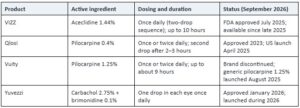
The practical difference between pilocarpine and aceclidine comes down to selectivity. Pilocarpine stimulates the ciliary muscle along with the iris, which can produce accommodative spasm, a myopic shift, brow ache and headache the complaints that limited uptake of the first generation.
Aceclidine targets the iris with minimal ciliary involvement, so near vision improves without pushing distance vision out of focus.
That said, no randomized head-to-head trial has directly compared aceclidine against pilocarpine or the newer carbachol-brimonidine combination.
Cross-trial comparisons look favorable for VIZZ, but they were run in different populations under different protocols, so treat any “best drop” claim with skepticism.
Yuvezzi takes a different route again, pairing a cholinergic agent with brimonidine to modulate the pupil, and its comparative data against established options is still limited.
Cost, Candidacy, and Where Drops Fit With Glasses and Contacts
Presbyopia drops sit in an awkward insurance category. Because they address an age-related lifestyle need rather than a sight-threatening disease, most vision and medical plans do not cover them.
Plan on paying cash: direct pricing from the manufacturer runs about $79 for a 25-dose supply or $198 for 75 doses (roughly $66 a month), with retail pharmacy prices generally in the $80 to $106 range and coupon pricing near $80. FSA or HSA eligibility varies, so check your plan before assuming.
The strongest candidates tend to be adults in their mid-40s to early 60s with early to moderate presbyopia, healthy retinas, clear lenses, minimal distance correction and a lifestyle that involves plenty of well-lit near work. Trials also included some post-LASIK and pseudophakic participants, so previous refractive surgery does not automatically disqualify you.
It also helps to be realistic about what a drop replaces. VIZZ can free you from reaching for readers through a workday, but the effect fades, so you will still want correction for evenings, low light and long reading sessions.
For most people, drops work best alongside not instead of a good pair of progressive lenses, multifocal contacts, or task-specific reading glasses.
They are also a far better answer than stacking up one-size-fits-all drugstore readers, which ignore the difference between your two eyes and any astigmatism you may have.
Finally, a drop does not stop presbyopia from progressing. The lens continues to stiffen with age, so your near prescription will keep drifting whether or not you use drops, and periodic re-evaluation stays important.
Frequently Asked Questions
Do presbyopia eye drops actually work?
Yes, for a majority of suitable candidates. In the Phase 3 CLARITY trials, 65% to 71% of VIZZ users gained three or more lines of near vision without losing distance clarity, compared with 8% to 12% on control. About three in ten did not reach that benchmark, so the response is real but not universal.
How long does VIZZ last per drop?
Near-vision improvement typically begins within about 30 minutes and was measured out to 10 hours in clinical studies. Individual duration varies with pupil size, lighting and the task at hand — many users find the effect strongest in the first several hours and softer toward the end of the day.
What are the side effects of aceclidine eye drops?
The most common are instillation-site irritation (20%), dim vision (16%), headache (13%) and eye redness (7–8%), and most were mild and short-lived. Rarer concerns include retinal tear or detachment, a risk shared by all miotic drops, along with caution for people with a history of iritis. Temporary dim vision means night driving deserves extra care.
Who is a good candidate for presbyopia drops?
Adults roughly 45 to 65 with early to moderate presbyopia, healthy retinas, clear lenses and mostly well-lit near work tend to do best. Poor candidates include people with significant cataract, retinal disease or iritis history, heavy night drivers, and anyone who already finds low-light vision difficult. A dilated retinal exam before starting is recommended on the label.
How much do presbyopia eye drops cost?
Expect roughly $79 a month direct from the manufacturer for 25 doses, or about $198 for a 90-day supply. Retail pharmacy pricing generally lands between $80 and $106 per carton. Insurance coverage is uncommon for this category, so most patients pay out of pocket.
Can I use VIZZ if I wear contact lenses?
Usually yes, with timing adjustments. The label addresses use with contact lenses, and the standard approach is to remove lenses before instilling the drop and wait before reinserting them. Confirm the exact interval with your optometrist, since it also depends on your lens type and tear film.
The Bottom Line: A Real Option, Not a Cure
Aceclidine gave the presbyopia category something it did not have before: a once-daily drop with a full workday of near-vision improvement and no meaningful trade-off in distance clarity for most users. That is a genuine advance over the first generation of pilocarpine drops. It is still a daily, out-of-pocket treatment with a dim-vision trade-off, a retinal-exam prerequisite and a response rate that leaves a real minority unimpressed.
If you are weighing it, three practical next steps:
- Get a comprehensive exam with a dilated retinal evaluation required before starting any miotic drop, and it rules out cataract or retinal disease driving your blur.
- Talk through your day honestly: how much night driving you do, how well-lit your reading is, and whether a 10-hour window actually covers your needs.
- Try it as a supplement, not a replacement. Keep an accurate near prescription on hand and see how often you still reach for it after a month.
Our optometrists at Village Eyecare see presbyopia every day across our Chicago locations in University Village, South Loop, Hyde Park, Wicker Park and Edgewater, and we can tell you frankly whether drops, lenses or a combination fits your eyes and your routine.
Book an appointment to have the conversation with your own exam findings in front of you.