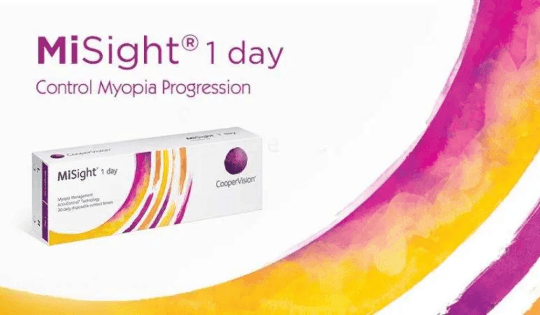
MiSight 1 day contact lenses are soft, single-use daily disposable lenses from CooperVision. They are the first and only soft contact lens approved by the U.S. Food and Drug Administration (FDA) to both correct nearsightedness and slow the progression of myopia in children aged 8 to 12 at the start of treatment.
Here is what the evidence shows, who qualifies, and what treatment involves.
Key Takeaways
|
What Is MiSight?
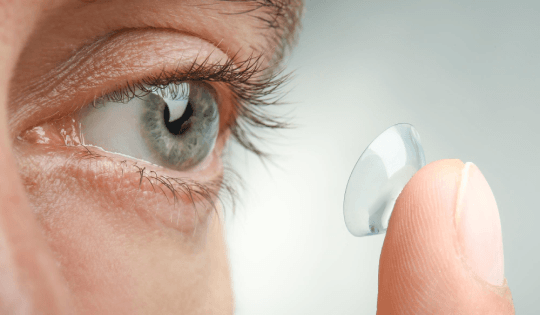
MiSight 1 day is a soft, hydrophilic (omafilcon A) contact lens worn during the day and discarded every night. Unlike a standard lens, which only sharpens vision, MiSight does two jobs: it corrects blurry distance vision and slows the eye growth that drives worsening nearsightedness.
That second job matters because myopia is not just an inconvenience that glasses fix. Nearsightedness develops when the eyeball grows too long from front to back. That elongation is permanent, and higher myopia carries greater lifetime risk of retinal detachment, glaucoma and myopic macular degeneration.
Slowing progression in childhood is the point of any myopia control program including MiSight.
How Dual-Focus Technology Works
MiSight uses concentric optical zones rather than one uniform prescription. Central zones deliver the child’s full distance correction, so vision is clear. Surrounding treatment zones create myopic defocus, focusing some light slightly in front of the peripheral retina an optical signal that appears to discourage further elongation. CooperVision calls this ActivControl Technology; clinically it is a dual-focus soft lens.
The design is optical, not pharmacological there is no medication in the lens.
Why Is MiSight FDA-Approved?
MiSight received FDA approval in November 2019 through the premarket approval (PMA) pathway the agency’s most stringent device route, requiring valid scientific evidence of safety and effectiveness. Most contact lenses reach the market via the lighter 510(k) process, which only requires substantial equivalence to an existing product. MiSight is the only soft lens to have cleared the higher bar for a myopia control claim.
The approved indication is specific, and it defines exactly what the FDA evaluated:
| MiSight 1 day (omafilcon A) soft contact lenses for daily wear are indicated for the correction of myopic ametropia and for slowing the progression of myopia in children with non-diseased eyes who, at the initiation of treatment, are 8–12 years of age and have a refraction of −0.75 to −4.00 diopters (spherical equivalent) with 0.75 diopters or less of astigmatism. The lens is discarded after each removal. |
Two clarifications. Approval confirms the lens performed as claimed in a controlled trial for a defined population; it is not a promise of a specific result for one child. And a doctor may still judge MiSight appropriate outside those parameters for a slightly older child, or a higher prescription, since powers to −7.00 D are now supplied in the U.S. That is an off-label decision your optometrist should explain directly.
How Effective Is MiSight?
In the pivotal three-year randomized trial published in Optometry and Vision Science (Chamberlain et al., 2019), 144 children aged 8–12 across four countries wore either MiSight or a visually identical single-vision daily lens. The MiSight group progressed 0.73 D less on average a 59% reduction and their eyes elongated 0.32 mm less, a 52% reduction in axial growth.
Longer-term follow-up adds context:
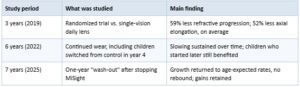
Parents ask most about the seven-year cessation study: when children stopped wearing MiSight, their eyes did not “catch up.” Axial growth in the untreated year was roughly 0.09–0.10 mm in line with untreated children of the same age.
One caveat: these are cohort averages. Some children respond more strongly than the mean, some less. No myopia control treatment stops progression entirely, and none reverses myopia that has already developed.
When Can Kids Start MiSight?
The FDA indication begins at age 8, and the evidence is strongest for children fitted between 8 and 12. Readiness depends on more than the calendar:
- Prescription: The studied range is −0.75 D to −4.00 D with minimal astigmatism, though wider powers exist.
- Progression rate: A child whose prescription climbs meaningfully each year has the most to gain from starting early.
- Maturity and hygiene: Your child must handle lenses, follow a wear schedule and speak up if an eye feels irritated. Many 8-year-olds manage this with supervision.
- Wear time: Clinical protocols called for at least 10 hours a day, 6 days a week; part-time wear reduces the expected benefit.
If your child is younger than 8 or has already stopped growing, other approaches may fit better.
A comprehensive pediatric eye exam including cycloplegic refraction and, where available, axial length measurement is what tells you whether MiSight is a sensible starting point.
Are MiSight Lenses Safe for Children?
The daily disposable format is itself a safety feature: a fresh sterile lens each morning removes solutions, cases and cleaning routines common sources of contamination in children.
The FDA’s Summary of Safety and Effectiveness Data reported no serious adverse events and no microbial keratitis in the pivotal study. A six-year ocular health analysis (Woods et al., Contact Lens and Anterior Eye, 2021) likewise found no lens-related serious adverse events, with corneal infiltrative events at a rate comparable to adults in daily disposables.
That is reassuring, not risk-free. All lens wear carries a small risk of corneal infection. The safeguards: clean hands before handling, never sleep in the lenses, never rinse or store them in water, discard after every removal, and call your eye doctor if an eye becomes red, painful or light-sensitive.
MiSight vs. Ortho-K and Other Myopia Control Options
MiSight is one of several evidence-based options. The usual comparison is with orthokeratology (ortho-k), where a rigid lens worn overnight temporarily reshapes the cornea so the child sees clearly all day without correction.
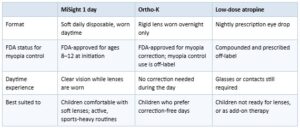
Myopia control spectacle lenses are another option; our parent’s guide to myopia control compares them in more detail. There is no universally superior choice the right one depends on your child’s prescription, age, progression rate, activities and comfort with lens handling.
How Much Do MiSight Contact Lenses Cost in Chicago?
There is no single MiSight price, and any figure quoted online is an illustration, not a quote. Chicago practices price MiSight as a treatment program rather than a product, because the lenses only work as part of ongoing monitored care. Your total typically reflects:
- The comprehensive eye examination and cycloplegic refraction
- The myopia management evaluation, which may include axial length measurement and topography
- The contact lens fitting, plus insertion, removal and hygiene training for your child
- The annual or six-month lens supply, plus power changes as the prescription updates
- Scheduled follow-up visits, usually at one week and then every six months
Because myopia management is often considered elective, standard vision insurance plans vary widely. Some apply a contact lens allowance toward the supply; medical insurance may cover diagnostic testing when rapid progression or high myopia is documented, and FSA and HSA funds are generally eligible.
Ask for a written breakdown of program fees and what your plan contributes before you commit.
What Do Parents and Children Report?
Published wearer-experience research from the MiSight trials gives a more reliable picture than anonymous online reviews. In those studies children reported high satisfaction with their vision and the lenses, most handled insertion and removal independently after training, and a large majority preferred lenses to glasses for sports. Six-year follow-up found good adherence to the recommended wear schedule.
Practically, the first two weeks are the adjustment period. Some children notice mild haloes or glare at night, which typically settles; your optometrist should ask about this at every follow-up.
What to Expect at a MiSight Fitting
- Comprehensive evaluation. A full eye exam sets the prescription, rules out other conditions and documents baselines for tracking progression.
- Risk discussion. Your optometrist reviews progression history, family history and lifestyle, then explains which options fit your child.
- Fitting and training. Diagnostic lenses confirm fit, comfort and vision; your child learns insertion, removal and hygiene. Expect a longer appointment.
- Ongoing monitoring. A one-week check confirms the lenses are settling, then six-month visits reassess prescription, fit, eye health and progression. Treatment typically continues for several years, until the eyes stabilize.
Even if your child already wears contacts, a MiSight fitting differs from a standard contact lens fitting: the goal includes tracking eye growth over time, not just clear vision today.
Frequently Asked Questions
Does MiSight cure or reverse myopia?
No. MiSight corrects vision and is designed to slow how quickly myopia worsens. Nearsightedness and eye elongation that have already occurred are not reversed by these or any other lenses.
Can my child wear MiSight lenses for sports and swimming?
Sports, yes many families choose contacts precisely for this. Swimming, no: lenses should never be worn in pools, lakes or hot tubs because of the risk of waterborne infection, including Acanthamoeba keratitis.
How long will my child need to wear MiSight?
Usually several years, commonly into the late teens when refractive error stabilizes. Your optometrist bases the stopping point on measured progression, not a fixed schedule.
What happens when my child stops wearing them?
The seven-year study found eye growth resumed at rates expected for untreated children of the same age, with no rebound acceleration and prior gains retained.
Is MiSight better than ortho-k?
Neither is universally better. MiSight has the strongest U.S. regulatory standing for myopia control and a simpler routine; ortho-k offers correction-free days and is well studied for slowing axial elongation, though that use is off-label. The decision usually turns on your child’s comfort with lens handling and your family’s routine.
Can MiSight be combined with other treatments?
Some doctors add low-dose atropine for children who continue to progress. Combination therapy has a growing but still developing evidence base and should only be pursued under supervision.
Get Fitted for MiSight at Village Eyecare
Childhood myopia is easier to manage the earlier it is caught, and the only way to know whether MiSight suits your child is a full evaluation.
Our optometrists across our Chicago neighborhood locations fit MiSight 1 day lenses as part of a monitored myopia management program, and we will walk you through the options, evidence and cost in plain terms. Schedule an appointment with Village Eyecare to get started.