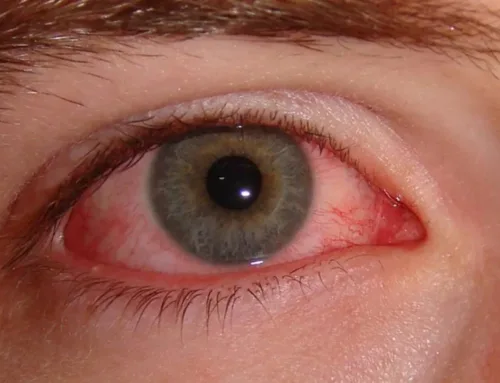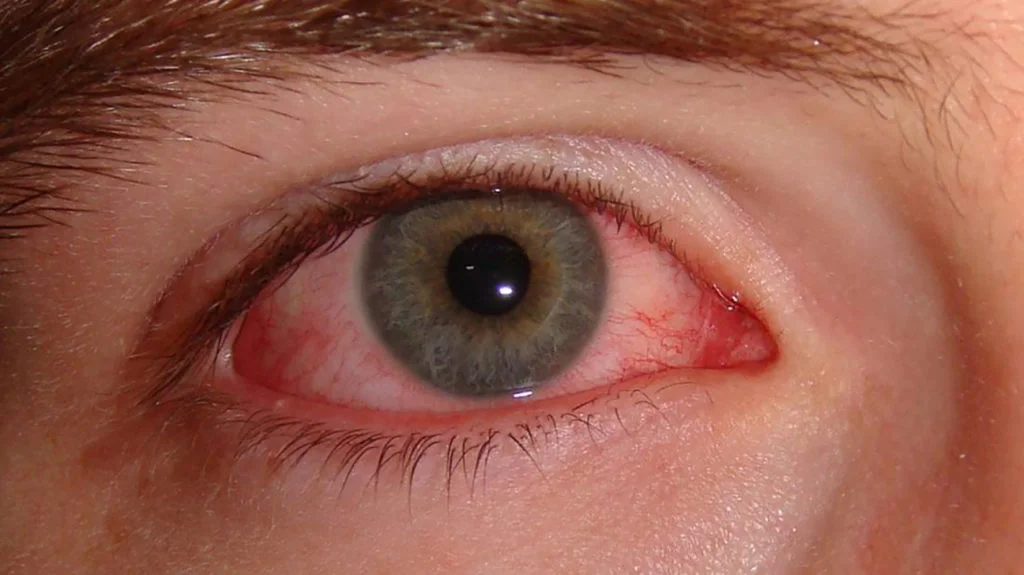
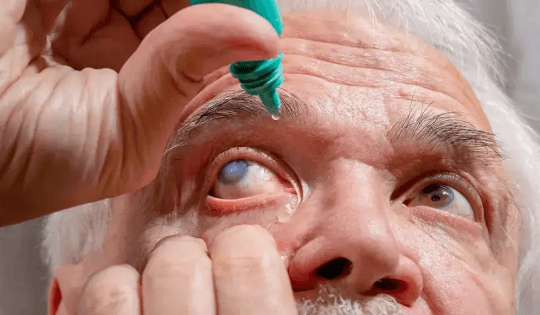
Vision changes with age. Vision loss is not inevitable. Most age-related vision loss in older adults traces back to three conditions cataracts, age-related macular degeneration (AMD), and glaucoma and all three can be identified during a dilated eye exam long before they change how you see.
That gap between detectable and noticeable is the whole reason senior eye care exists as its own category of care.
Key Takeaways
|
What Is Senior Eye Care?
Senior eye care is ongoing, medically focused eye examination and disease management for adults roughly 60 and older, built around detecting age-related eye disease before it produces symptoms.
It is not a vision screening or a quick check for new glasses. A screening measures how well you read a chart. A comprehensive eye exam evaluates the structures of the eye itself lens, optic nerve, retina and macula, drainage angle, and internal pressure usually with dilation, because the back of the eye cannot be properly examined through a small pupil.
How Often Should Seniors Get Eye Exams?
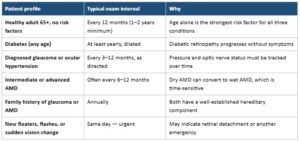
Most adults 65 and older should have a comprehensive dilated eye exam at least every one to two years, and yearly if they have any risk factor, diagnosed eye condition, or new visual symptom.
Guidance differs slightly by organization. The American Academy of Ophthalmology (AAO) recommends every one to two years for adults 65+, even without symptoms. The American Optometric Association (AOA) recommends an annual exam for all adults 18 and older.
In practice most eye doctors move seniors to a yearly schedule, because risk rises with age and annual intervals make change easier to detect.
Why Are Eye Exams More Frequent for Seniors?
- Age is the dominant risk factor. Cataracts, AMD, and open-angle glaucoma all become substantially more common with each decade after 60.
- The serious conditions are silent first. Glaucoma damages peripheral vision before central vision, and the brain compensates so effectively that many people notice nothing until permanent loss has occurred.
- The eye reveals systemic disease. The retina is the one place in the body where blood vessels and nerve tissue are directly visible. Diabetes and hypertension often show changes there.
- Vision loss compounds after 65. Reduced vision is associated with falls, medication errors, driving limitations, and social isolation — so a missed diagnosis costs more later in life.
The Three Conditions That Matter Most After 60
Cataracts
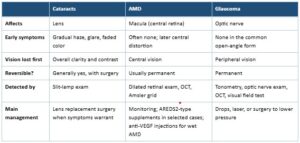
A cataract is a clouding of the eye’s natural lens that scatters light and reduces contrast. It develops gradually and is age-related in most cases, with UV exposure, smoking, diabetes, and long-term corticosteroid use recognized as contributing factors.
Typical symptoms: cloudy or dimmed vision, glare and halos around headlights at night, faded or yellowed colors, needing brighter light to read, and frequent prescription changes. Cataract vision loss is usually reversible the clouded lens can be replaced. More detail on our cataracts patient education page.
Age-Related Macular Degeneration (AMD)
AMD damages the macula, the small central area of the retina responsible for sharp, straight-ahead vision. It rarely causes total blindness because peripheral vision is preserved, but it can make reading, driving, and recognizing faces very difficult. Dry (atrophic) AMD progresses slowly; wet (neovascular) AMD involves leaking blood vessels beneath the retina and can worsen rapidly.
AMD warning signs to report promptly:
- Straight lines door frames, tile grout, text margins appearing wavy or bent
- A blurred, dim, or blank spot in the centre of your vision
- Difficulty recognizing faces at conversational distance
- Needing progressively more light to read the same material
- Any sudden change in central vision wet AMD is time-sensitive and warrants same-week evaluation
See our macular degeneration information page for more.
Glaucoma
Glaucoma is a group of diseases that damage the optic nerve, often but not always alongside elevated pressure inside the eye. Primary open-angle glaucoma, the most common form, is painless and produces no early symptoms. Loss begins peripherally and is irreversible, which is why glaucoma is described as a leading cause of irreversible blindness.
Treatment slows or halts further damage it cannot restore vision already lost.
Recognized risk factors include age, family history, African or Hispanic ancestry, high eye pressure, thin corneas, and diabetes. Angle-closure glaucoma is different sudden severe eye pain, headache, nausea, and halos around lights signal a medical emergency.
More on our glaucoma patient guide.
How Are AMD, Cataracts, and Glaucoma Detected?
All three are detected during a comprehensive dilated eye examination, combining imaging, pressure measurement, and direct examination of the lens, optic nerve, and retina.
- Visual acuity and refraction — establishes best-corrected vision and tracks change.
- Slit-lamp examination — magnified view of the lens; how cataracts are graded.
- Tonometry — measures intraocular pressure, one input in glaucoma assessment.
- Dilated fundus examination — direct view of the retina, macula, and optic nerve head.
- Optical coherence tomography (OCT) — cross-sectional retinal imaging that can reveal macular fluid or drusen in AMD and nerve fiber layer thinning in glaucoma, often before vision changes.
- Visual field testing — maps peripheral vision to identify and track glaucomatous loss.
- Amsler grid — a simple at-home tool for monitoring central distortion in AMD.
Dilation blurs near vision and increases light sensitivity for several hours, so plan not to drive yourself afterward and bring sunglasses.
When Is Surgery Considered?
For cataracts, surgery is considered when the cataract interferes with what you need or want to do — not when you reach a particular age.
There is no minimum or ideal cataract surgery age. A 68-year-old who has stopped driving at night or cannot read prescription labels may be a clear candidate, while an 82-year-old with mild lens changes and comfortable vision may reasonably wait.
The procedure removes the clouded lens and implants an intraocular lens (IOL). The deciding questions are functional:
How is your night driving? Can you read what you need to read?
Have you narrowed your activities because of your vision?
For glaucoma, management usually begins with pressure-lowering drops. If pressure stays above the target set for your optic nerve, laser procedures such as selective laser trabeculoplasty or surgical options including minimally invasive glaucoma surgery may be discussed. The goal is preserving remaining vision.
For AMD, there is no surgical cure. Dry AMD is monitored, and the antioxidant-and-zinc formulation studied in the National Eye Institute’s AREDS2 trial is recommended for certain patients with intermediate or advanced disease an individual decision, not a blanket supplement recommendation.
Wet AMD is commonly treated with anti-VEGF injections to reduce leakage; response varies between individuals. As an optometry practice, we diagnose, monitor, and co-manage these conditions and refer to surgical specialists when a procedure is indicated.
Does Medicare Cover Eye Exams for Seniors?
Original Medicare (Parts A and B) does not cover routine eye exams for glasses or contact lenses, but Part B covers a defined set of medically necessary eye services.
Coverage rules and cost-sharing change yearly, so confirm current details at Medicare.gov or with your plan.
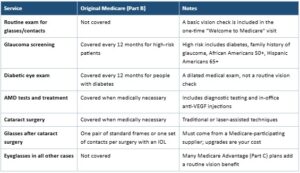
For covered Part B services you generally pay 20% of the Medicare-approved amount after the annual Part B deductible, with a possible additional copayment in a hospital outpatient setting. Our vision insurance page explains which plans we work with, and our team can check your benefits before you come in.
Senior Eye Care in Chicago: Access and Planning
Transportation is a real barrier for many older adults worth planning around rather than postponing care over.
- Neighborhood locations. Village Eyecare has offices across Chicago, including Hyde Park, South Loop, University Village, Wicker Park, and Edgewater.
- Hyde Park and nearby retirement communities. Our Hyde Park optometry office is convenient for residents of Hyde Park, Kenwood, and Woodlawn, including seniors in nearby independent and assisted living communities.
- Transport and accessibility. Our locations are reachable by CTA bus and rail. If you are being dilated, arrange a ride, a family member, or paratransit for the return trip.
- What to bring. Current glasses, a full medication and supplement list, your Medicare or insurance card, and your primary care physician’s name so results can be shared.
Frequently Asked Questions
How often should seniors get eye exams?
At least every one to two years for adults 65+ per the AAO, and annually per the AOA. Anyone with diabetes, glaucoma, macular changes, or a family history of eye disease should be examined at least yearly, or more often if their eye doctor advises.
Does Medicare cover eye exams?
Not routine ones. Original Medicare does not pay for exams to update a glasses or contact lens prescription. Part B does cover annual glaucoma screening for high-risk patients, annual dilated exams for people with diabetes, AMD testing and treatment, cataract surgery, and one pair of glasses or contacts after cataract surgery with an intraocular lens. Many Medicare Advantage plans add routine vision coverage.
What are the earliest AMD warning signs?
Straight lines appearing wavy, a blurred or dim spot in the centre of vision, trouble recognizing faces, and needing much more light to read. Early AMD often has no symptoms at all, which is why dilated exams and OCT imaging matter more than how your vision feels.
At what age is cataract surgery usually done?
There is no set cataract surgery age. It is a functional decision based on symptoms night driving difficulty, glare, trouble reading rather than a birthday or a number on the chart.
Can glaucoma be cured?
No. Progression can be slowed with drops, laser, or surgery, but optic nerve damage already done cannot be reversed. That is exactly why detection before symptoms appear is so valuable.
Is a vision screening at a senior center or pharmacy enough?
No. Screenings can flag reduced acuity but do not include dilation, pressure measurement, optic nerve evaluation, or retinal imaging the tests that actually detect glaucoma and AMD. A screening is a prompt to book a comprehensive exam, not a substitute for one.
Can anything reduce my risk?
Nothing eliminates risk, but evidence supports not smoking, wearing UV-blocking sunglasses, managing blood pressure and blood sugar, eating leafy greens and fish, and staying active. None of these replace regular examination.
Schedule a Senior Eye Exam
If it has been more than a year since your last comprehensive dilated exam or if you have noticed night glare, faded colors, wavy lines, or a change in your side vision that is a reason to be seen, not a reason to wait. Two of these three conditions cause damage that cannot be undone.
Schedule a senior eye exam at any Village Eyecare location or call the office nearest you. Our team can verify your Medicare or vision plan benefits in advance, so you know what to expect before you arrive.