Essilor Stellest vs HOYA MiYOSMART: Myopia Control Glasses for Kids Compared
Short answer:
Stellest (Essilor) and MiYOSMART (HOYA) are both myopia control glasses that slow how quickly a child’s nearsightedness worsens, using tiny lenslets arranged around a clear central zone. Stellest uses highly aspherical lenslets (HAL) and is the only spectacle lens FDA-authorized for this purpose in the U.S., for children aged 6 to 12. MiYOSMART uses DIMS technology and has strong international evidence, but it is not approved or sold in the U.S.
Key Takeaways
- Both lenses correct blurry distance vision and slow myopia progression compared with ordinary single-vision glasses.
- In FDA-reviewed two-year data, Stellest slowed myopia progression by 71% and eye growth by 53% versus single-vision lenses.
- MiYOSMART slowed progression by roughly half in its two-year trial, but U.S. families currently cannot buy it.
- Wear time drives results: children should wear the glasses at least 12 hours a day.
- Stellest’s suggested U.S. retail price is about $450 for the lenses, and some vision plans now process it.
How Myopia Control Glasses Work: DIMS vs HAL Lenses
Standard single-vision glasses focus light sharply at the centre of the retina, but they can leave peripheral light focused slightly behind it. Researchers believe that signal encourages a child’s eye to keep growing longer. A longer eye means a stronger prescription every year and, later in life, a higher risk of retinal detachment, glaucoma, cataract and myopic maculopathy.
Myopia control glasses keep the centre of the lens clear for sharp vision while adding “myopic defocus” in the periphery. That peripheral signal is designed to slow axial elongation, which is the real driver of worsening myopia.
MiYOSMART (DIMS lenses). HOYA developed Defocus Incorporated Multiple Segments technology with The Hong Kong Polytechnic University. A 9 mm clear zone sits inside a honeycomb ring of small segments, each about 1 mm wide with +3.50 D of relative plus power. Normal single-vision correction remains available in the gaps between segments.
Stellest (HAL lenses). Essilor’s design pairs a 9 mm clear centre with 11 concentric rings of highly aspherical lenslets. Essilor says the aspherical shape creates a volume of defocus in front of the retina rather than a single focal plane.
From across the room, both look like regular children’s glasses. Up close, you may see faint dots. Some kids notice mild blur or halos in their side vision at first. The FDA reported no serious adverse events in the Stellest trial, and most children adapt within about a week.
Stellest vs MiYOSMART: Effectiveness, Availability and Cost
Here is how the two spectacle lenses that slow myopia compare on the factors parents ask about most.
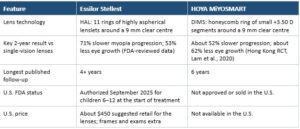
Percentages come from separate trials with different children and methods, so they are not a direct head-to-head comparison.
Which lens is more effective?
No large randomized trial has yet compared DIMS vs HAL lenses head to head. Retrospective studies in China and a French cohort of more than 2,500 children found HAL lenses performed slightly better, while a European study found more DIMS wearers had zero progression at two years.
Both clearly beat ordinary glasses. In practice, how many hours a child actually wears the lenses matters more than the small difference between brands.
What this means for families in Chicago
Because MiYOSMART is not sold in the U.S., Stellest is currently the spectacle lens option a myopia management clinic in Chicago can prescribe. HOYA is testing a newer MiYOSMART iQ design with promising early results, but it is also not U.S.-approved. If your child already wears MiYOSMART from another country, bring their prescription history and axial length records so your eye doctor can plan a smooth switch.
Budget for more than the lenses. The roughly $450 lens price excludes frames, the initial myopia assessment and follow-up visits. Children often need updated lenses about once a year as their prescription changes or they outgrow frames.
Check your vision plan, as some insurers, including UnitedHealthcare’s Spectera network, now process Stellest orders.
Who Should Get Myopia Glasses for Kids, and How They Compare With MiSight
The FDA authorized Stellest for children aged 6 to 12 when treatment begins. Outside the U.S., DIMS lenses have also been used in children as young as 4. Starting early matters because myopia tends to progress fastest before age 10.
Myopia control glasses are a strong fit when a child:
- Is nearsighted and the prescription has worsened over the past year
- Developed myopia young, or has one or both parents who are nearsighted
- Is too young, or not ready, to handle contact lenses
- Will reliably wear glasses all day, at school and at home
MiSight 1 day is a daily disposable soft contact lens the FDA approved in 2019 for children aged 8 to 12 at the start of wear. In its three-year trial, it slowed myopia progression by about 59% and eye growth by about 52%. Effectiveness is broadly similar to myopia control glasses, so the choice usually comes down to lifestyle.
Contacts suit active children who play sports; glasses avoid the small infection risk of contact lenses and are easier for 6- and 7-year-olds. Some children with fast progression also benefit from low-dose atropine drops added to their lenses.
One safety note: highly nearsighted children have a greater lifetime risk of retinal problems. If your child suddenly reports flashes, a shower of new floaters or a shadow across their vision, seek urgent eye care in Chicago the same day rather than waiting for a routine appointment.
Frequently Asked Questions
Do myopia control glasses actually work?
Yes, for most children. Randomized trials show both Stellest and MiYOSMART slow myopia progression by roughly half or more compared with single-vision glasses. They slow, but do not stop or reverse, myopia, and results depend on consistent daily wear.
What is the difference between Stellest and MiYOSMART?
Stellest uses rings of highly aspherical lenslets (HAL), while MiYOSMART uses a honeycomb of defocus segments (DIMS). Both work on the same principle. The biggest practical difference for U.S. families is availability: only Stellest is FDA-authorized and sold in the U.S.
How much do myopia control glasses cost?
Stellest has a suggested U.S. retail price of about $450 for the lenses. Frames, the myopia assessment and follow-up visits are usually extra. Some vision insurance plans cover part of the cost, so ask your clinic to check your benefits.
At what age can a child start myopia control lenses?
In the U.S., Stellest is authorized for children who are 6 to 12 years old when treatment starts. Your optometrist will consider your child’s age, prescription, rate of progression and family history.
Are myopia control glasses better than MiSight contacts?
Neither is clearly better. Both slow progression by a similar amount in trials. Glasses suit younger children and those not ready for contacts, while MiSight suits older, active children aged 8 to 12 who can handle daily lens care.
Does my child need to wear the glasses all day?
Yes. Studies show the best results in children who wear their myopia control glasses at least 12 hours a day. Wearing them only for school or screen time reduces the benefit.
Next Steps: Getting Myopia Control Glasses in Chicago
Myopia control glasses are one of the simplest, lowest-risk ways to protect a child’s long-term eye health. For U.S. families, Stellest is the available spectacle option today, and the best results come from early treatment and consistent wear.
Here is how to get started:
- Book a myopia assessment. Look for optometrists in Chicago who measure axial length, not just prescription, so progression can be tracked accurately.
- Compare options together. Discuss Stellest, MiSight and atropine with your doctor based on your child’s age, habits and progression rate.
- Commit to follow-ups. Plan visits about every six months to confirm the treatment is working.
- Build healthy habits. Encourage around two hours of outdoor time daily and regular breaks from close-up screen work.
Many Chicago eyecare clinics now offer dedicated myopia management programs.
Scheduling an evaluation this school year gives your child the best chance of slowing their myopia while their eyes are still growing.
This article is for general education and is not a substitute for a professional eye examination. Treatment choices should be made with a licensed eye care provider.