
Ortho-K for adults works and there is no upper age limit in the FDA-approved indication. Orthokeratology (ortho-k) uses custom rigid gas-permeable lenses worn overnight to temporarily reshape the cornea, so you wake up, take the lenses out, and see clearly all day without glasses or daytime contacts.
The technique was originally popularized for slowing myopia progression in children, which is why most adults assume they aged out of it. They didn’t. Adults are fit successfully in their twenties, thirties, forties and beyond, provided the prescription, corneal shape and ocular surface are suitable.
Key Takeaways
- Ortho-k is FDA-approved for overnight wear and carries no upper age restriction adults are eligible candidates, not exceptions.
- The effect is temporary and reversible. Lenses must be worn nightly (or on a schedule your optometrist sets) to maintain clear daytime vision.
- It is approved for reducing myopia (near-sightedness), often with mild astigmatism. It does not treat presbyopia, cataracts or eye disease.
- Adult ortho-k is primarily about lifestyle freedom swimming, contact sports, dusty or smoky environments, tactical work rather than myopia control.
- It is a reasonable option for people who are not candidates for laser surgery due to thin corneas, dry eye, an unstable prescription, or personal preference.
- Overnight lens wear carries a real, small risk of corneal infection. Success depends heavily on hygiene, follow-up visits and a properly measured fit.
What Is Ortho-K, and How Does It Work?
Orthokeratology also called corneal reshaping, corneal refractive therapy (CRT) or vision shaping treatment (VST) is a non-surgical method of correcting refractive error.
You sleep in a precisely engineered rigid gas-permeable lens. Overnight, the lens redistributes the epithelial cells on the front surface of the cornea, flattening the central zone just enough to bring light to a sharp focus on the retina.
In the morning you remove the lens. The cornea holds its new shape for most or all of the waking day. Because the epithelium naturally regenerates, the effect fades if you stop wearing the lenses usually within days to a couple of weeks and your original prescription returns. That reversibility is one of the main reasons adults choose it over surgery.
The U.S. Food and Drug Administration approved the first overnight orthokeratology lens in 2002, and several lens systems are approved today, including Paragon CRT, Bausch + Lomb’s VST designs and Euclid. The approved indication is the temporary reduction of myopia in non-diseased eyes not a permanent cure. Learn more about our approach to orthokeratology at Village EyeCare.
Can Adults Do Ortho-K?
Yes. Adults can do ortho-k, and adult orthokeratology is a routine part of specialty contact lens practice. The FDA labeling for approved corneal reshaping lenses does not set an age ceiling and published long-term case series include large proportions of adult wearers with good refractive predictability.
What age can adults start ortho-k?
Any age at which the prescription is stable and the eye is healthy. In practice, the ideal window for adults opens once myopia has stopped progressing commonly in the early twenties and stays open indefinitely. Someone starting ortho-k at 21 and someone starting at 45 go through the same fitting process.
When is it too late for ortho-k?
It is rarely a matter of age and almost always a matter of eye health. Ortho-k becomes unsuitable when there is significant corneal disease or scarring, active infection or inflammation, severe untreated dry eye, an irregular cornea from keratoconus or previous surgery, or a prescription outside the range the lens design can correct.
Cataract development or advanced presbyopia can also shift the conversation toward other options.
One honest limitation: ortho-k corrects distance vision. If you are over 40 and already reaching for readers, corneal reshaping will not restore near focus.
Some practitioners fit a modified monovision approach one eye weighted for distance, one for intermediate or near but the evidence base for presbyopic ortho-k is thinner than for straightforward myopia correction, and adaptation varies. Read more about presbyopia and how it changes near vision.
How Is Adult Ortho-K Different from Kids’ Ortho-K?
The lens technology is the same. The clinical goal, the tissue you are working with, and the support system around the patient are not.
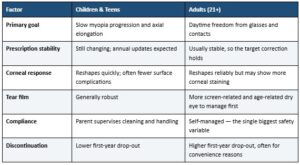
A practical implication for adults: the ocular surface has to be addressed first. Years of screen work, contact lens wear, LASIK, or medications that reduce tear production can leave a cornea that will not tolerate an overnight lens until the dryness is treated. That is a sequencing problem, not a disqualification.
If your eyes already feel gritty by mid-afternoon, start with a dry eye evaluation and treatment before pursuing corneal reshaping.
Why Don’t More Adults Know About Ortho-K?
Three reasons, none of them clinical:
- Marketing followed the pediatric story. When myopia-control research accelerated, ortho-k was positioned as a children’s treatment, and adult messaging largely disappeared.
- Laser surgery dominates adult refractive advertising. LASIK, PRK and SMILE have far larger promotional budgets and a simpler pitch.
- It requires a specialty fit. Ortho-k needs corneal topography, custom lens design and multiple follow-ups so it is offered by a subset of optometry practices rather than universally.
Ortho-k is not new or experimental. It is a well-established, FDA-regulated modality that simply gets less airtime with adult patients. It also sits alongside our laser vision correction co-management services rather than competing with them the right answer depends on your eyes.
Ortho-K for Athletes, Swimmers and Tactical Professionals in Chicago
This is where adult ortho-k earns its reputation. Because correction lives in the cornea rather than on it, your eyes are effectively “empty” during the day.
- Swimmers and triathletes: No lenses in the water. This matters because swimming in contact lenses is a recognized risk factor for Acanthamoeba keratitis, a rare but serious infection associated with water exposure.
- Combat sports, hockey, basketball, rugby: No lens dislodging on impact, no fogged or shattered spectacle lenses under a helmet or cage.
- First responders and firefighters: Smoke, heat, particulates and SCBA masks are hostile to daytime lenses and glasses alike.
- Military applicants and cadets: Field conditions make lens care difficult. Ortho-k concentrates all handling into a controlled home environment. Note that vision standards differ by branch and specialty, and some programs restrict overnight lens wear during training confirm with your recruiter or unit medical officer before starting.
- Winter runners and cyclists on the Lakefront Trail: No lenses drying out in Chicago wind, no lenses fogging when you step indoors.
Related reading: can I swim with contact lenses?
Ortho-K vs. LASIK vs. Daily Disposables
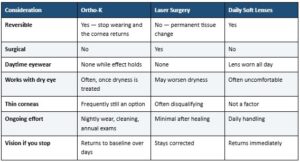
Who Is a Good Candidate?
Your optometrist will map your cornea with topography and evaluate tear film, corneal health and prescription before making any recommendation.
Broadly, adult ortho-k tends to suit people who:
- Have low-to-moderate myopia, with or without mild astigmatism
- Have a stable prescription and healthy, non-diseased corneas
- Want or need to be glasses-free during the day but do not want surgery
- Were turned down for laser correction, or are waiting until their prescription stabilizes
- Sleep a reasonably consistent 6–8 hours
It is generally not appropriate for people with active corneal infection or inflammation, keratoconus or other irregular corneas, significant untreated dry eye, high prescriptions beyond the design range, or an inability to commit to meticulous lens hygiene and scheduled follow-ups. Shift workers with erratic sleep can sometimes be fit, but it takes planning.
What to Expect: Fitting, Timeline and Cost
Ortho-k is a fitting process, not a single appointment.
- Evaluation: Comprehensive eye exam plus corneal topography to map curvature and confirm candidacy.
- Lens design and dispense: Custom lenses are ordered to your corneal measurements; you are taught insertion, removal and care.
- First nights: Many people notice meaningful improvement within the first few days. Fluctuating vision, glare or halos early on are common as the cornea settles.
- Stabilization: Full, consistent correction commonly takes one to several weeks, longer for higher prescriptions. Some patients wear backup glasses during this period.
- Follow-up: Morning-after and staged follow-up visits, then ongoing annual assessments and periodic lens replacement.
On cost: adult ortho-k typically involves a higher upfront investment than a year of soft lenses, because the fee covers topography, custom lens design, multiple follow-up visits and the lenses themselves.
Fees vary by practice and prescription complexity. Many vision plans treat it as a specialty contact lens fitting with partial benefits, and FSA or HSA funds are often eligible. Ask for a written breakdown before you begin.
Safety: What the Evidence Actually Shows
Any overnight lens wear increases the risk of corneal infection compared with daily wear, and FDA labeling for ortho-k lenses states this plainly. The most serious complication is microbial keratitis rare but potentially sight threatening.
Published estimates of microbial keratitis in ortho-k wearers fall in the range of a handful of cases per 10,000 patient-years, broadly comparable to other overnight lens modalities and to refractive surgery complication rates. Some analyses have found lower rates in adults than in children, likely reflecting differences in handling and hygiene.
The most common day-to-day finding in adults is corneal staining superficial surface disruption that is usually manageable with fit adjustment and better lens care.
Risk is not evenly distributed. It concentrates in wearers who rinse lenses with tap water, top off solution, skip cleaning, sleep in lenses while unwell, or stop attending follow-ups. Do those things correctly and you are in the safest group; skip them and no lens design will protect you. Contact your eye doctor promptly for redness, pain, light sensitivity or sudden blur.
Frequently Asked Questions
Can adults do ortho-k after 30 or 40?
Yes. Ortho-k over 30 is common, and there is no upper age limit in the approved indication. The practical question is whether presbyopia has begun, since corneal reshaping addresses distance vision only.
How long does it take to see clearly?
Many people see a noticeable improvement within the first several days, with vision stabilizing over roughly one to a few weeks. Higher prescriptions take longer.
Do I have to wear the lenses every night?
Most adults do. Some with lower prescriptions can maintain adequate vision on a slightly reduced schedule, but that is determined by your optometrist based on measured results not assumed.
Is ortho-k permanent?
No. It is fully reversible. Stop wearing the lenses and your cornea gradually returns to its original shape, typically within days to a couple of weeks.
Does ortho-k hurt?
It should not. There is usually lens awareness in the first few nights, which fades as you adapt. You sleep through the reshaping itself.
Can I still have LASIK later?
Generally yes, but you must discontinue lens wear for a period, so the cornea returns to its true shape before surgical measurements are taken. Your surgeon will specify how long.
Does ortho-k treat astigmatism?
Approved designs address myopia with mild-to-moderate astigmatism. Higher or irregular astigmatism usually calls for a different specialty lens.
Schedule an Adult Ortho-K Evaluation in Chicago
If you are a swimmer, athlete, first responder, or simply someone who is tired of daytime lenses and not interested in surgery, the next step is a candidacy evaluation corneal mapping, tear film assessment and a clear conversation about whether ortho-k fits your eyes and your schedule.
Village Eyecare fits specialty lenses across our Chicago locations, including University Village, South Loop, Hyde Park, Wicker Park and Edgewater.
Schedule an adult ortho-k evaluation to find out whether corneal reshaping is right for you.